Creating high-quality content and optimizing your website are essential parts of SEO, but they are not the only factors that can influence search visibility. Search engines also consider signals from outside your website when evaluating its authority, relevance, and credibility.
This is where Off-Page SEO becomes important.
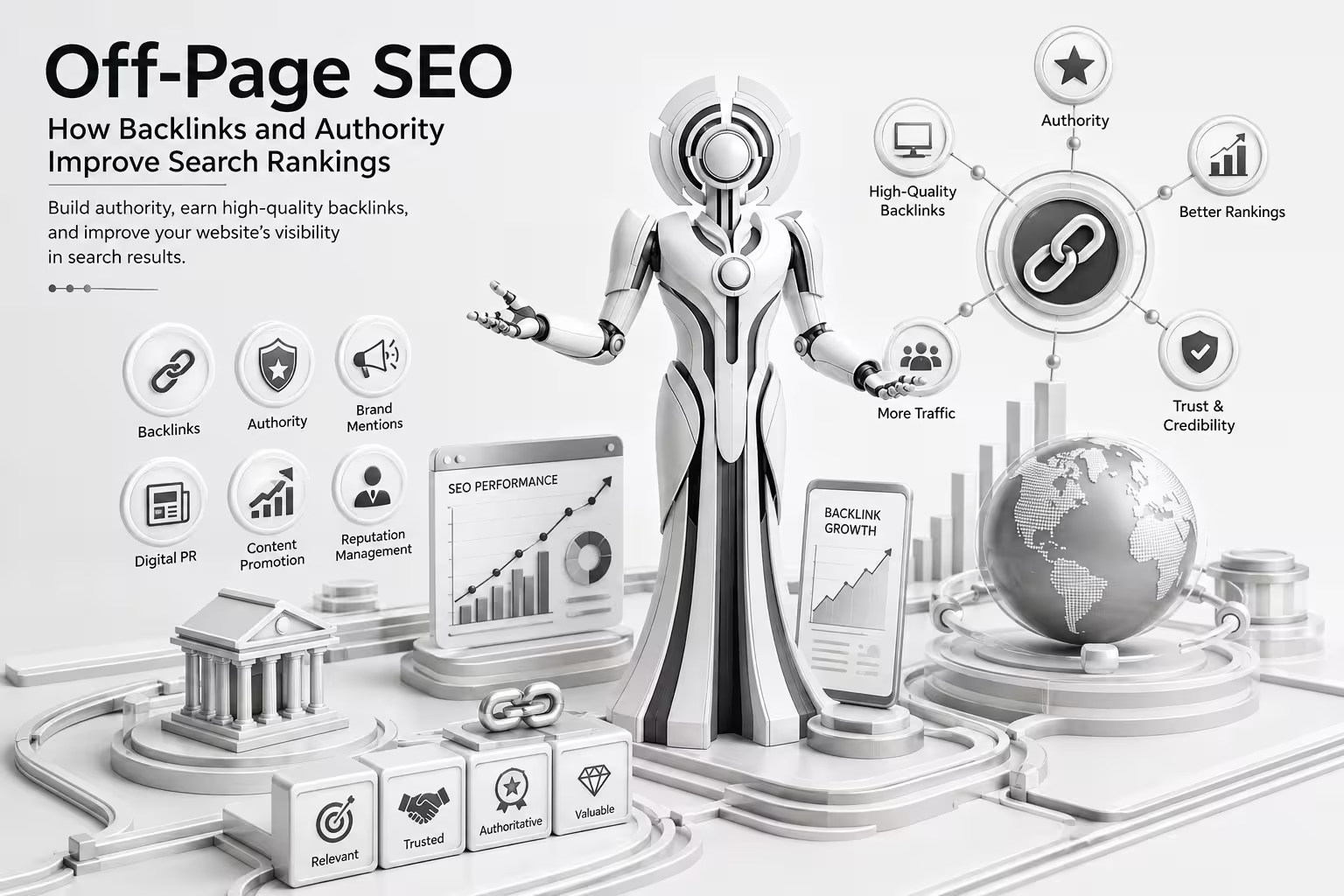
Off-Page SEO focuses on activities performed outside your website to improve its reputation and authority in search engines. Link building, backlinks, brand mentions, digital PR, and online reputation are some of the key areas involved in an effective off-page SEO strategy.
In this guide, we will explain what Off-Page SEO is, why backlinks matter, how link building works, and how businesses can build stronger website authority in 2026.
What Is Off-Page SEO?
Off-Page SEO refers to SEO activities that take place outside your own website and can influence how search engines perceive your website’s authority, relevance, and credibility.
While On-Page SEO focuses on elements you control directly on your website, Off-Page SEO focuses on external signals.
Important Off-Page SEO activities include:
- Link building
- Earning high-quality backlinks
- Digital PR
- Brand mentions
- Content promotion
- Online reputation management
- Relevant business citations
- Building relationships within your industry
The goal is not simply to collect as many links as possible. A strong Off-Page SEO strategy focuses on earning relevant, trustworthy signals that support your website and content.
Why Is Off-Page SEO Important?
Search engines need multiple signals to determine how trustworthy and useful a website may be.
If reputable and relevant websites naturally reference your content, those references can help demonstrate that your website provides useful information.
Effective Off-Page SEO can help with:
Improving Website Authority
High-quality backlinks and positive mentions can contribute to the overall authority and credibility of a website.
Increasing Search Visibility
A strong backlink profile can support your ability to compete for relevant search queries, particularly in competitive industries.
Driving Referral Traffic
Backlinks are not only useful for SEO. A link from a relevant website can send interested visitors directly to your website.
Building Brand Awareness
Content promotion, PR, industry mentions, and partnerships can introduce your business to new audiences.
Supporting Long-Term SEO Growth
A healthy off-page presence can complement your content and technical SEO efforts and contribute to sustainable organic growth.
What Are Backlinks?
A backlink is a link from another website to your website.
For example, if an industry publication writes an article about SEO and links to a useful guide on your website, that link is a backlink.
Backlinks can vary significantly in quality.
A relevant link from a trusted and authoritative website can be much more valuable than a large number of irrelevant or low-quality links.
When evaluating backlinks, consider factors such as:
- Relevance of the linking website
- Quality of the linking page
- Context surrounding the link
- Editorial nature of the link
- Reputation of the website
- Potential referral traffic
The quality and relevance of backlinks are generally more important than simply increasing the total number of links.
What Is Link Building?
Link building is the process of acquiring backlinks from other websites.
However, modern link building should focus on earning valuable links rather than manipulating search rankings.
Some legitimate link-building methods include:
- Creating useful original content
- Digital PR
- Guest contributions on relevant websites
- Resource page outreach
- Industry partnerships
- Expert interviews
- Original research and statistics
- Creating useful tools and resources
- Recovering unlinked brand mentions
The best link-building campaigns give publishers a genuine reason to reference your website.
Types of Backlinks
Not every backlink carries the same value or context.
Editorial Backlinks
Editorial backlinks are links that a publisher naturally includes because your content is useful or relevant to its audience.
These are often among the most valuable types of backlinks because they are earned based on the usefulness of your content.
Guest Post Links
A business may contribute an article to a relevant publication and include a link where it genuinely helps readers.
Guest posting should focus on providing valuable information rather than producing articles solely to obtain links.
Resource Links
If your website contains a useful guide, research report, calculator, checklist, or other resource, relevant websites may link to it as a reference.
Business and Local Citations
Businesses can also receive mentions and links through relevant directories, local organizations, industry associations, and business profiles.
These should be accurate, relevant, and genuinely useful rather than created in large quantities simply for SEO.
What Makes a Backlink High Quality?
One of the biggest mistakes in Off-Page SEO is assuming that every backlink is equally valuable.
A high-quality backlink generally has several positive characteristics.
Relevance
The linking website or page should have some meaningful connection to your topic, industry, audience, or content.
Authority
A link from an established and reputable website can provide stronger credibility than a link from a low-quality website.
Editorial Context
A naturally placed link within useful content is generally more meaningful than a link placed randomly or in a large collection of unrelated links.
Real Audience
A website with an actual audience can provide referral traffic in addition to an SEO benefit.
Natural Placement
The link should make sense within the content and provide value to the reader.
The objective should always be to build a natural backlink profile rather than manipulate search results.
Domain Authority vs. Search Engine Rankings
You may have heard the term Domain Authority when discussing SEO.
Domain Authority is a third-party metric used by some SEO platforms to estimate the strength of a website’s backlink profile and its potential ability to rank.
It is important to understand that Domain Authority is not a Google ranking factor.
Different SEO tools use their own metrics and calculations, so a Domain Authority score should be treated as a comparative SEO measurement rather than a direct Google ranking score.
Instead of focusing only on increasing a particular authority score, businesses should focus on earning relevant backlinks, creating useful content, building a reputable brand, and improving the overall quality of their website.
How to Build High-Quality SEO Backlinks
Building strong backlinks requires a strategic approach.
1. Create Link-Worthy Content
The easiest way to earn valuable backlinks is to create something other websites genuinely want to reference.
Examples include:
- Original research
- Industry reports
- Detailed guides
- Statistics pages
- Case studies
- Free tools
- Templates
- Checklists
- Expert insights
Useful resources give other publishers a reason to link to your website.
2. Promote Your Content
Publishing great content does not guarantee that people will discover it.
Promote your content through relevant channels such as:
- Industry communities
- Social media
- Email outreach
- Professional networks
- Content partnerships
- Digital PR
The more relevant people who discover useful content, the greater the opportunity for natural mentions and backlinks.
3. Use Digital PR
Digital PR can help businesses earn coverage and mentions from publications, news websites, industry websites, and other authoritative sources.
Businesses can create PR opportunities by sharing:
- Original research
- Industry trends
- Expert commentary
- New products or services
- Company insights
- Relevant data
The objective is to provide something genuinely newsworthy or useful.
4. Build Industry Relationships
Relationships can create valuable opportunities for collaboration and content promotion.
Connect with:
- Industry experts
- Bloggers
- Journalists
- Business owners
- Professional organizations
- Relevant publishers
Long-term relationships can be more valuable than one-time link-building campaigns.
5. Find Unlinked Brand Mentions
Sometimes websites mention your business without linking to your website.
You can identify these mentions and contact the publisher to request a relevant link when appropriate.
This is often a relatively simple opportunity because the website has already mentioned your brand.
What Is a Natural Backlink Profile?
A natural backlink profile contains links that are acquired from different relevant sources over time.
You may receive links from:
- Industry publications
- Blogs
- News websites
- Business organizations
- Partners
- Educational resources
- Local websites
- Professional communities
The profile should not look artificially created around a single tactic.
Natural link acquisition usually happens as a result of publishing useful content, building relationships, promoting resources, and establishing a recognizable brand.
Off-Page SEO Mistakes to Avoid
Poor link-building practices can create problems rather than improve your SEO.
Buying Large Numbers of Backlinks
Buying links specifically to manipulate rankings can violate search engine spam policies and may put your website at risk.
Using Irrelevant Links
A backlink from an unrelated website simply because it exists is not necessarily valuable.
Excessive Exact-Match Anchor Text
Using the exact same keyword-rich anchor text repeatedly can create an unnatural backlink profile.
Link Farms and Spam Networks
Networks created primarily to generate artificial backlinks can be risky and provide little genuine value.
Low-Quality Guest Posting
Publishing low-quality articles on unrelated websites purely to obtain backlinks is not a sustainable SEO strategy.
Focusing Only on Authority Scores
Third-party metrics can be useful for comparison, but they should not become the primary objective of your SEO campaign.
The focus should remain on relevance, quality, trust, and genuine value.
Off-Page SEO vs. On-Page SEO
On-Page SEO and Off-Page SEO work together but focus on different areas.
On-Page SEO focuses on elements within your website, such as:
- Content
- Title tags
- Meta descriptions
- Headings
- Internal links
- URLs
- Images
- Page structure
Off-Page SEO focuses on external signals, such as:
- Backlinks
- Brand mentions
- Digital PR
- Online reputation
- Industry relationships
- Content promotion
A website may have excellent content but struggle to compete in a highly competitive search result without sufficient authority and recognition.
Similarly, having many backlinks does not make up for poor content or a poor user experience.
The strongest SEO strategies combine both.
How Off-Page SEO Services Can Help Your Business
Professional Off-Page SEO services can help businesses develop and manage a structured authority-building strategy.
An SEO professional may help with:
- Backlink profile analysis
- Competitor backlink research
- Link-building opportunities
- Digital PR campaigns
- Content promotion
- Brand mention monitoring
- Outreach strategies
- Toxic or suspicious backlink analysis
- Industry relationship building
The right strategy depends on your industry, competitors, website authority, content quality, and business goals.
How to Measure Off-Page SEO Success
Off-Page SEO should not be measured only by the number of backlinks acquired.
Useful metrics include:
- Organic search visibility
- Keyword rankings
- Referring domains
- Quality of earned backlinks
- Referral traffic
- Brand mentions
- Organic traffic
- Leads and conversions
A smaller number of highly relevant backlinks can be more valuable than hundreds of low-quality links.
Off-Page SEO Checklist
Before launching an Off-Page SEO campaign, review the following:
- Create valuable, link-worthy content
- Analyze your existing backlink profile
- Research relevant competitor backlinks
- Identify industry-specific link opportunities
- Build relationships with relevant publishers
- Promote valuable content
- Monitor brand mentions
- Pursue relevant digital PR opportunities
- Avoid spammy link-building tactics
- Track referring domains and referral traffic
- Monitor organic visibility and rankings
- Focus on quality rather than backlink quantity
Final Thoughts
Off-Page SEO plays an important role in building the authority, credibility, and visibility of a website.
Backlinks remain an important part of the SEO landscape, but successful link building is not about collecting as many links as possible. It is about earning relevant, trustworthy, and contextually useful links from websites that have a genuine reason to reference your content.
Businesses that combine high-quality content, technical SEO, On-Page SEO, content promotion, digital PR, and ethical link building can create a stronger foundation for long-term organic growth.
If your website needs help building authority and earning high-quality SEO backlinks, professional Off-Page SEO services can help you develop a sustainable strategy based on your industry, competitors, and business goals.