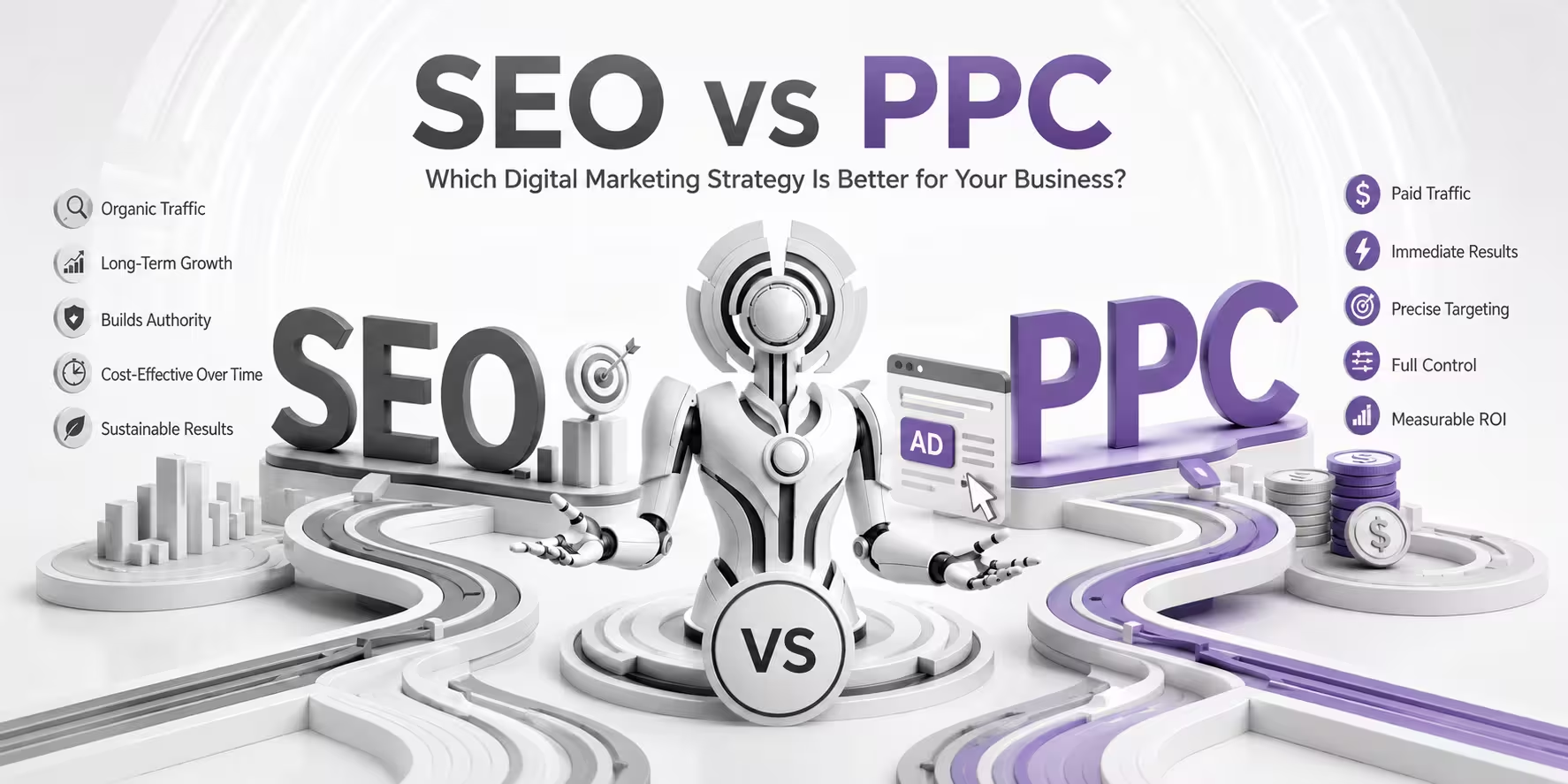
Discover how SEO vs PPC can help your business reach more customers online. Compare the benefits, costs, and results of SEO and PPC to choose the right strategy.
Should you invest in SEO to build long-term organic traffic, or should you use PPC advertising to generate immediate paid traffic?
The answer depends on your business goals, budget, competition, industry, and how quickly you need results.
In this guide, we’ll compare SEO and PPC, explain how each strategy works, discuss their advantages and disadvantages, and help you determine which approach may be better for your business.
What Is SEO?
SEO stands for Search Engine Optimization.
SEO is the process of improving a website so that it can appear more prominently in organic search engine results.
When someone searches for a product, service, or question, search engines determine which pages are most relevant and useful.
A strong SEO strategy can help your website attract organic traffic without paying for every individual click.
SEO marketing can include:
- Keyword research
- Content optimization
- Technical SEO
- On-page SEO
- Internal linking
- Local SEO
- Website performance optimization
- Link building
- Content marketing
The main advantage of SEO is that it can create long-term search visibility when implemented consistently.
What Is PPC?
PPC stands for Pay-Per-Click.
PPC advertising allows businesses to pay for advertisements that appear on search engines and other online platforms.
With search advertising, businesses can bid on keywords and potentially display ads when people search for related terms.
For example, a business offering web design services might create a PPC campaign targeting searches related to:
- Web design services
- Website development company
- WordPress website design
- Ecommerce website development
When users click on the advertisement, the advertiser typically pays for that click.
PPC can provide businesses with a faster way to reach potential customers compared with waiting for organic rankings to develop.
SEO vs PPC: What’s the Difference?
The biggest difference between SEO and PPC is how traffic is generated.
SEO
SEO focuses on earning visibility in organic search results through website optimization, useful content, technical improvements, and authority building.
PPC
PPC focuses on paying for advertisements that appear in designated advertising areas of search results or other platforms.
In simple terms:
SEO = Earn organic visibility
PPC = Pay for advertising visibility
Both can be effective, but they serve different purposes.
SEO vs PPC Comparison
| Factor | SEO | PPC |
|---|---|---|
| Traffic type | Organic | Paid |
| Initial results | Usually slower | Usually faster |
| Long-term potential | High | Depends on ongoing ad spend |
| Cost per click | No direct payment for organic clicks | Advertiser pays for clicks |
| Budget requirement | Investment in SEO work | Requires advertising budget |
| Control over targeting | Moderate | High |
| Results after stopping investment | Can continue | Paid traffic generally stops |
| Best for | Long-term growth | Immediate campaigns |
Neither strategy is automatically better for every business.
Benefits of SEO
1. Builds Long-Term Organic Traffic
One of the biggest advantages of SEO is its potential to generate ongoing organic traffic.
Once a page achieves strong visibility for relevant search terms, it can continue attracting visitors without paying for each click.
However, rankings are not permanent. Competitors can improve their websites, search results can change, and content may need to be updated.
2. Builds Online Authority
A strong SEO presence can help establish your business as a useful and trustworthy resource in your industry.
High-quality content can demonstrate expertise and answer questions potential customers have before making a decision.
3. Can Reduce Dependence on Paid Advertising
Businesses that rely entirely on paid search need to maintain advertising budgets to keep generating paid traffic.
SEO provides another source of visibility that can complement paid advertising.
4. Supports Different Types of Search Intent
SEO can target informational, commercial, navigational, and transactional searches.
For example, a business can create:
- Educational blog posts
- Service pages
- Product pages
- Comparison guides
- Location pages
This allows SEO to support customers at different stages of the buying journey.
5. Can Deliver Strong Long-Term Value
SEO is generally a long-term investment.
Although it may take time to build rankings, successful pages can continue generating traffic and potential customers over an extended period.
Disadvantages of SEO
SEO also has limitations.
Results Can Take Time
SEO usually does not produce the same immediate visibility as a paid advertising campaign.
Competition Can Be High
Competitive keywords may require significant time and resources.
Requires Ongoing Work
Search results, competitors, websites, and user behavior change over time.
Rankings Are Not Guaranteed
No legitimate SEO provider can guarantee a specific ranking position.
Benefits of PPC Advertising
1. Faster Visibility
One of the biggest advantages of PPC advertising is speed.
Once a campaign is approved and running, advertisements can begin appearing for targeted searches.
This can be useful for businesses launching:
- New products
- Limited-time offers
- Seasonal promotions
- Special campaigns
- New services
2. Precise Targeting
PPC platforms can provide advertisers with extensive targeting options.
Depending on the platform and campaign type, businesses may be able to target audiences based on factors such as:
- Keywords
- Location
- Device
- Audience characteristics
- Time
- Interests
- Remarketing signals
This can make PPC useful when businesses want greater control over who sees their advertisements.
3. Easy-to-Measure Campaign Data
PPC campaigns can provide detailed data about advertising performance.
Businesses can track metrics such as:
- Clicks
- Impressions
- Click-through rate
- Cost per click
- Conversions
- Cost per conversion
- Advertising spend
- Revenue
This data can be used to optimize campaigns and budgets.
4. Useful for Testing
PPC can be used to test:
- Keywords
- Offers
- Landing pages
- Headlines
- Calls to action
- Products
The information gathered from paid campaigns can sometimes provide useful insights for broader digital marketing activities.
Disadvantages of PPC
Ongoing Costs
PPC requires continuous advertising spend.
Traffic Can Stop When Ads Stop
When a campaign is paused or the budget runs out, paid traffic generally stops.
Competitive Keywords Can Be Expensive
Popular commercial keywords can have high advertising costs.
Poor Campaign Management Can Waste Budget
Incorrect targeting, weak landing pages, irrelevant keywords, or poorly optimized campaigns can lead to inefficient spending.
SEO Marketing vs PPC Advertising
The choice between SEO marketing and PPC advertising often depends on your business goals.
If your priority is:
Long-term organic visibility → SEO may be the better choice.
If your priority is:
Immediate paid visibility → PPC may be the better choice.
But businesses do not necessarily have to choose only one.
SEO and PPC can work together.
When Should Your Business Choose SEO?
SEO may be a strong option if you want to:
- Build long-term organic traffic
- Increase search visibility
- Establish industry authority
- Generate ongoing leads
- Reduce dependence on paid traffic
- Target informational searches
- Build sustainable online visibility
SEO can be particularly valuable for businesses that are willing to invest in long-term growth.
Examples of Businesses That Can Benefit From SEO
SEO can be useful for:
- Local businesses
- Service companies
- Ecommerce stores
- SaaS companies
- Professional services
- Blogs and publishers
- Agencies
- B2B companies
The strategy will vary depending on the business model and target audience.
When Should Your Business Choose PPC?
PPC may be more appropriate when you need:
- Immediate traffic
- Fast lead generation
- Quick product visibility
- Seasonal promotion
- Event promotion
- Controlled advertising campaigns
- Highly targeted paid traffic
For example, a business launching a limited-time offer may use PPC to reach potential customers immediately rather than waiting for organic rankings.
SEO vs PPC for Small Businesses
Small businesses often have limited marketing budgets, so choosing where to invest can be difficult.
SEO can help build long-term visibility, particularly for businesses targeting specific local or niche searches.
PPC can provide faster exposure but requires ongoing advertising spend.
A practical approach may be to use PPC for immediate opportunities while gradually building organic visibility through SEO.
For example:
Short term → PPC
Long term → SEO
This combination can help businesses balance immediate and future growth.
SEO vs PPC for Ecommerce
Ecommerce businesses can benefit from both strategies.
SEO for Ecommerce
SEO can help product and collection pages appear for organic searches such as:
- Best running shoes
- Buy office chairs online
- Women’s winter jackets
- Wireless headphones
Organic rankings can generate ongoing product discovery.
PPC for Ecommerce
PPC can be useful for:
- New products
- Promotional campaigns
- High-converting products
- Seasonal sales
- Shopping campaigns
Using both strategies can provide a broader approach to ecommerce marketing.
SEO vs PPC: Which Is More Cost-Effective?
There is no universal answer.
SEO requires investment in:
- Strategy
- Content
- Technical optimization
- Website improvements
- Link building
- Ongoing maintenance
PPC requires advertising spend and campaign management.
The right choice depends on your customer acquisition costs, competition, conversion rate, average order value, and business goals.
For some businesses, PPC may produce a positive return quickly.
For others, investing in SEO may provide stronger long-term value.
The best way to compare the two is to evaluate cost against business outcomes, not simply traffic.
Can SEO and PPC Work Together?
Yes.
In fact, combining SEO and PPC can create a strong digital marketing strategy.
For example:
PPC Can Provide Immediate Traffic
Use paid search to promote important services, products, or offers while SEO work is underway.
SEO Can Build Long-Term Visibility
Create and optimize content and landing pages that can generate organic traffic over time.
PPC Data Can Support SEO
Paid campaigns can reveal which keywords, messages, and offers generate strong engagement or conversions.
SEO Data Can Support PPC
Organic search data can help identify valuable keywords and topics for paid campaigns.
Together, SEO and PPC can provide both short-term and long-term visibility.
How to Build a Combined SEO and PPC Strategy
A combined strategy could look like this:
Step 1: Identify High-Value Keywords
Find keywords that are relevant to your products, services, and target audience.
Step 2: Use PPC for Immediate Opportunities
Run paid campaigns for high-priority commercial searches where immediate visibility is valuable.
Step 3: Build Organic Content
Create useful landing pages, service pages, product pages, and informational content around relevant search topics.
Step 4: Improve Your Website
Optimize technical performance, page experience, content, internal linking, and conversion paths.
Step 5: Analyze Results
Compare organic and paid performance based on:
- Traffic
- Leads
- Sales
- Conversion rate
- Cost per acquisition
- Revenue
Step 6: Adjust Your Budget
Invest more in the channels that are producing the strongest business results while continuing to build long-term opportunities.
Common SEO and PPC Mistakes
Treating SEO as a Quick Fix
SEO requires time and consistent effort. Avoid expecting instant results.
Running PPC Without Tracking Conversions
Clicks alone do not tell you whether your advertising is generating business value.
Ignoring Landing Pages
Even a well-targeted PPC campaign can perform poorly if visitors arrive on confusing or irrelevant landing pages.
Focusing Only on Rankings
SEO rankings are useful, but qualified traffic, leads, sales, and revenue are more important business outcomes.
Using Only One Marketing Channel
Depending entirely on a single source of traffic can create unnecessary risk.
A balanced digital marketing strategy can provide greater flexibility.
How Long Does SEO Take Compared With PPC?
This is one of the clearest differences between the two.
PPC can generate visibility quickly, assuming campaigns are approved, properly configured, and funded.
SEO generally takes longer because search engines need to discover, evaluate, and rank your pages against competing websites.
However, SEO can continue generating organic traffic after the initial optimization work, whereas PPC traffic generally depends on ongoing advertising spend.
This is why businesses often use PPC for immediate needs while building SEO for long-term growth.
Frequently Asked Questions About SEO vs PPC
Is SEO better than PPC?
Neither is universally better. SEO is generally focused on long-term organic visibility, while PPC is designed to provide paid visibility more quickly. The best option depends on your business goals and budget.
Is PPC faster than SEO?
Yes. PPC can generally provide paid visibility much faster than SEO can produce significant organic rankings.
Is SEO cheaper than PPC?
Not necessarily. SEO requires investment in strategy, content, technical optimization, and ongoing work. However, organic traffic does not require paying for each individual click.
Can I use SEO and PPC together?
Yes. Many businesses use both to generate immediate paid traffic while building long-term organic visibility.
Which is better for a new website?
A new website may benefit from PPC if immediate visibility is important, while SEO can be developed simultaneously to build long-term organic traffic.
Which strategy is better for long-term growth?
SEO can be particularly valuable for long-term organic growth, but PPC can continue to play an important role in customer acquisition and promotional campaigns.
Final Thoughts
The SEO vs PPC debate is not really about choosing one strategy forever.
SEO and PPC serve different purposes.
SEO marketing focuses on building organic visibility, authority, and long-term traffic.
PPC advertising focuses on generating targeted paid traffic quickly and giving businesses greater control over advertising campaigns.
For many businesses, the strongest approach is to use both.
PPC can help generate immediate opportunities while SEO builds a sustainable organic presence over time.
The right strategy depends on your industry, competition, budget, customer journey, and business goals.
Instead of asking whether SEO or PPC is universally better, ask:
Which combination of organic and paid search can deliver the best results for my business?
When properly planned and measured, SEO and PPC can work together to increase visibility, attract qualified visitors, generate leads, and support long-term business growth.