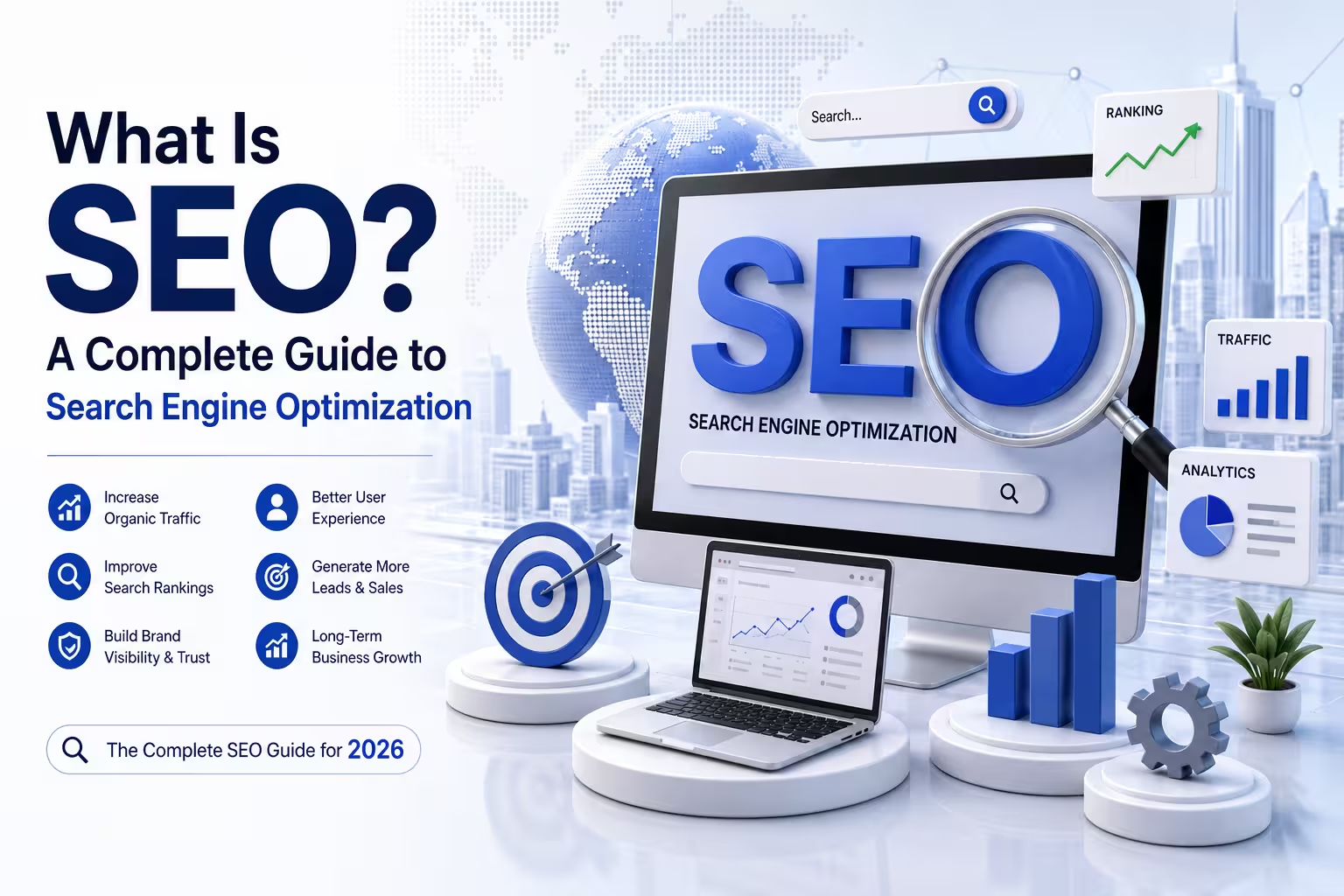
In today’s digital world, having a website is not enough. What is SEO, and why does it matter? Learn how SEO helps people find your website, attract valuable traffic, and reach potential customers online.
This is where SEO Services come in.
SEO, or Search Engine Optimization, is the process of improving a website so that it can appear more prominently in search engine results. A well-planned SEO strategy can help businesses increase organic traffic, improve online visibility, reach their target audience, and generate more leads without depending entirely on paid advertising.
In this complete guide, we’ll explain what SEO is, how it works, why it matters in 2026, and how businesses can build an effective SEO strategy.
What Is SEO?
SEO stands for Search Engine Optimization. It refers to the techniques and practices used to improve a website’s visibility in search engine results.
When someone searches for something on Google or another search engine, the search engine analyzes thousands or millions of pages to determine which results are most relevant and useful.
For example, if someone searches for:
“best digital marketing agency”
search engines try to show pages that provide the most relevant and helpful information about that topic.
SEO helps your website become more understandable, useful, and trustworthy to both search engines and users.
The ultimate goal of SEO is not simply to rank for keywords. It is to attract the right visitors and provide them with a useful experience that can lead to actions such as contacting your business, making a purchase, booking a service, or subscribing to your website.
Why Is SEO Important in 2026?
Search behavior has changed significantly over the years. People now use search engines not only to find websites but also to research products, compare services, find local businesses, answer questions, and make purchasing decisions.
This makes search visibility extremely important for businesses.
A strong SEO presence can help your business:
- Increase organic traffic
- Improve brand visibility
- Reach potential customers
- Generate qualified leads
- Build online credibility
- Improve website usability
- Reduce dependence on paid advertising
- Support long-term business growth
Unlike paid advertising, where traffic generally stops when you stop paying, successful SEO can continue generating organic traffic over time.
However, SEO is not a one-time task. Search engines continuously update their systems, competitors publish new content, and user behavior changes. Businesses therefore need an ongoing SEO strategy.
How Do Search Engines Work?
To understand SEO, it helps to understand the basic process search engines use.
Search engines generally work through three major stages:
1. Crawling
Search engines use automated programs, often called crawlers or bots, to discover and visit web pages.
These crawlers follow links between pages and collect information about websites.
2. Indexing
After discovering a page, the search engine analyzes its content and stores information about it in its index.
If a page is not properly indexed, it may not appear in search results.
3. Ranking
When someone performs a search, the search engine evaluates relevant pages and determines which results should appear and in what order.
Many different signals can influence rankings, including relevance, content quality, website performance, links, usability, and the overall quality of the website.
This is why SEO involves much more than simply adding keywords to a page.
The Main Types of SEO
SEO can be divided into several important areas. A successful SEO strategy usually combines all of them.
On-Page SEO
On-page SEO focuses on elements that exist directly on your website.
This can include:
- Page titles
- Headings
- Meta descriptions
- URL structure
- Keyword usage
- Content quality
- Internal linking
- Image optimization
- Content organization
The purpose is to make your pages easier for search engines to understand while also making them useful for visitors.
For example, instead of creating a page that repeatedly uses the same keyword, modern SEO focuses on creating comprehensive content that naturally addresses the user’s search intent.
Technical SEO
Technical SEO focuses on the technical aspects of a website that can affect crawling, indexing, performance, and user experience.
Important technical SEO areas include:
- Website speed
- Mobile responsiveness
- HTTPS security
- XML sitemaps
- Robots.txt
- Canonical URLs
- Structured data
- Crawlability
- Indexability
- Broken links
- Core Web Vitals
A technically strong website gives search engines a clearer path to discovering and understanding its content.
Off-Page SEO
Off-page SEO involves activities outside your own website that can contribute to its authority and reputation.
One of the best-known examples is link building.
When reputable and relevant websites link to your content, those links can contribute to your website’s authority. However, quality is much more important than simply collecting a large number of links.
Other off-page activities can include:
- Digital PR
- Brand mentions
- Relevant backlinks
- Industry relationships
- Content promotion
The goal should be to build genuine authority rather than manipulate search rankings.
Local SEO
Local SEO is particularly important for businesses that serve customers in specific geographic areas.
For example, a:
- Plumber
- Restaurant
- Dental clinic
- Law firm
- Digital marketing agency
- Home service company
may want to appear when people search for services in a specific city or area.
Local SEO can involve optimizing your Google Business Profile, maintaining consistent business information, earning relevant local mentions, collecting genuine reviews, and creating useful location-focused content.
What Are SEO Services?
SEO Services are professional services designed to improve a website’s visibility in search engines and attract more relevant organic traffic.
Depending on the business and its goals, SEO services may include:
- SEO audits
- Keyword research
- Competitor analysis
- On-page SEO
- Technical SEO
- Content optimization
- Local SEO
- Link building
- Website structure optimization
- Performance optimization
- SEO reporting and monitoring
A professional SEO company usually starts by understanding the business, its target audience, competitors, existing website performance, and search opportunities.
The strategy is then developed around those findings.
What Is an SEO Strategy?
An SEO strategy is a structured plan for improving a website’s search visibility and achieving specific business objectives.
A good SEO strategy usually includes several stages.
Step 1: Understand the Business
Before choosing keywords, you need to understand:
- What the business offers
- Who its customers are
- Which locations it serves
- What problems customers have
- What makes the business different
- What actions the business wants visitors to take
Step 2: Perform Keyword Research
Keyword research helps identify the words and phrases potential customers use when searching online.
For example, a company providing SEO services might target keywords related to:
- SEO services
- SEO company
- technical SEO services
- local SEO services
- WordPress SEO services
The goal is not to target every possible keyword. Instead, businesses should focus on relevant keywords that match their products, services, audience, and search intent.
Step 3: Analyze Competitors
Competitor analysis can reveal:
- Which keywords competitors target
- What type of content they publish
- Which pages attract traffic
- How their websites are structured
- What backlinks they have
- Which content opportunities may be missing
This information can help identify opportunities for your own website.
Step 4: Optimize Existing Pages
Before creating hundreds of new pages, it is often useful to improve the content and technical quality of existing pages.
This may involve improving:
- Titles
- Headings
- Content depth
- Internal links
- URLs
- Images
- Metadata
- Page speed
- User experience
Step 5: Create Helpful Content
Content remains an important part of SEO.
However, publishing content simply to target keywords is not enough.
Good SEO content should answer real questions, solve problems, demonstrate expertise, and provide genuine value to readers.
Step 6: Build Authority
Relevant backlinks, brand mentions, useful resources, and digital PR can help strengthen a website’s authority.
The focus should always be on earning valuable links and mentions rather than using spammy tactics.
Step 7: Monitor and Improve
SEO requires continuous monitoring.
Businesses can track:
- Organic traffic
- Search rankings
- Click-through rates
- Conversions
- Indexed pages
- Search queries
- Technical issues
- Backlinks
The data can then be used to improve the SEO strategy over time.
What Is the Difference Between SEO and Paid Advertising?
SEO and paid advertising can both help businesses generate website traffic, but they work differently.
With paid advertising, businesses pay platforms to display advertisements to potential customers.
With SEO, businesses work to improve their organic search visibility.
SEO
- Generates organic traffic
- Can provide long-term benefits
- Requires ongoing optimization
- Does not require paying for every individual click
- Can build long-term authority
Paid Advertising
- Can generate traffic quickly
- Requires an advertising budget
- Stops generating paid traffic when campaigns stop
- Allows detailed targeting
- Can be useful for immediate campaigns
For many businesses, SEO and paid advertising can work together as part of a broader digital marketing strategy.
How Long Does SEO Take to Work?
One of the most common SEO questions is how quickly results can be expected.
There is no universal timeline.
SEO results depend on factors such as:
- Website age
- Competition
- Industry
- Website quality
- Existing authority
- Content quality
- Technical condition
- Target keywords
- Backlink profile
- Consistency of optimization
Some improvements may produce results relatively quickly, while competitive keywords can take significantly longer.
SEO should therefore be viewed as a long-term investment rather than a guaranteed overnight solution.
Common SEO Mistakes to Avoid
Businesses sometimes make SEO more difficult by focusing on shortcuts instead of building a strong foundation.
Here are some common mistakes to avoid.
Keyword Stuffing
Repeating a keyword unnaturally throughout a page can make content difficult to read and does not create a good user experience.
Use keywords naturally and focus on satisfying the search intent.
Publishing Low-Quality Content
Creating large amounts of thin or unhelpful content simply to target keywords can weaken a website’s overall content quality.
Focus on useful, original, and relevant information.
Ignoring Technical SEO
Even excellent content can struggle if search engines cannot properly crawl or index a website.
Technical SEO should therefore be part of every comprehensive SEO strategy.
Buying Spammy Backlinks
Large numbers of low-quality or irrelevant backlinks can create problems rather than helping a website.
Focus on relevance, quality, and genuine authority.
Ignoring Mobile Users
A large portion of web traffic comes from mobile devices. A website should provide a smooth experience across different screen sizes.
Expecting Instant Results
SEO takes time. Businesses should evaluate progress using meaningful metrics rather than expecting immediate first-page rankings.
How to Choose an SEO Company
If you are considering professional SEO Services, choosing the right SEO company is important.
Before hiring an agency or consultant, consider:
Experience
Look for experience relevant to your industry, website platform, and business goals.
Clear Strategy
A professional SEO provider should be able to explain what they plan to improve and why.
Transparent Reporting
You should receive clear information about work completed, performance, progress, and areas that need improvement.
Realistic Expectations
Be cautious of companies promising guaranteed #1 rankings or instant results.
SEO depends on many factors, including competition and search engine algorithms.
Focus on Business Results
Rankings are useful, but they are not the final goal.
A successful SEO campaign should ultimately help generate meaningful outcomes such as qualified traffic, leads, enquiries, sales, or revenue.
SEO for Different Types of Websites
SEO strategies can vary depending on the type of website.
WordPress SEO
WordPress websites can benefit from optimizing site structure, content, metadata, performance, internal linking, technical settings, and plugins.
Shopify SEO
Shopify stores require a strong focus on product pages, collections, technical structure, internal linking, content, and ecommerce search visibility.
Ecommerce SEO
Online stores often have hundreds or thousands of pages, making product structure, category pages, filters, duplicate content, and internal linking especially important.
Local Business SEO
Local businesses need to focus on location-based searches, business information, reviews, local content, and local visibility.
The best approach depends on the website and its specific goals.
What Makes a Good SEO Campaign Successful?
A successful SEO campaign is built around more than rankings.
The strongest campaigns combine:
Technical Foundation + Helpful Content + Search Intent + Authority + User Experience + Continuous Improvement
Each component supports the others.
A technically optimized website with poor content may struggle to satisfy users. Similarly, excellent content may not perform well if search engines cannot properly access or index the website.
SEO works best when all major areas are addressed together.
Frequently Asked Questions About SEO
Is SEO still important in 2026?
Yes. Search engines remain an important way for people to discover information, products, services, and businesses. As search behavior evolves, businesses need to adapt their SEO strategies rather than abandoning SEO.
Can I do SEO myself?
Yes. Website owners can learn and implement many SEO techniques themselves. However, larger or highly competitive websites may benefit from professional SEO services and specialized expertise.
How much do SEO Services cost?
SEO pricing varies depending on factors such as website size, competition, industry, services required, and campaign goals. There is no single price that applies to every business.
Does SEO guarantee first-page rankings?
No reputable SEO provider can guarantee a specific ranking position. Search results are influenced by many factors outside an SEO provider’s complete control.
What is organic traffic?
Organic traffic refers to visitors who reach your website through unpaid search engine results.
Are keywords still important for SEO?
Keywords remain useful for understanding what users are searching for and creating relevant content. However, modern SEO goes beyond exact keyword matching and focuses heavily on relevance, search intent, content quality, and user experience.
Final Thoughts
SEO is one of the most valuable long-term strategies for building online visibility.
From technical optimization and keyword research to helpful content, local visibility, and authority building, effective SEO requires a complete and consistent approach.
Whether you are running a small local business, an ecommerce store, a WordPress website, or a growing company, investing in the right SEO Services can help you attract more relevant visitors and turn search visibility into meaningful business opportunities.
The key is to focus on the user first, build a technically strong website, publish genuinely useful content, and continuously improve based on data.
SEO is not about chasing search engine rankings. It is about building a better website that deserves to be found.