
What is Technical SEO? The UK Business Guide to Search Infrastructure
Imagine building a stunning, state-of-the-art flagship store on London’s Regent Street. You invest heavily in beautiful window displays, fill the shelves with premium stock, and hire an exceptional customer service team. But there is a fundamental flaw: the front doors are structurally jammed, the lights only turn on half the time, and the floor plan is so confusing that customers leave out of sheer frustration.
In the digital world, this is exactly what happens when you build a website with exceptional content but neglect its underlying structural foundation.
No matter how compelling your copywriting is or how revolutionary your products are, your website will fail to gain traction if search engines cannot access, read, and understand its code. This is where technical SEO comes into play. It is the silent, structural engine that powers your entire digital marketing strategy, ensuring your business is highly visible to both human users and modern search systems.
Optimize Your Foundation Today
Is hidden code debt stalling your business growth? Don’t let indexing errors or poor site speed compromise your visibility. Get a Free Technical SEO Audit from Rankers Pro today to discover and eliminate structural bottlenecks.
Quick Answer: Technical SEO Defined at a Glance
For business owners, founders, and marketing heads, understanding the technical SEO meaning does not require learning how to write complex code.
Technical SEO Definition
Technical SEO is the process of optimizing a website’s backend architecture and server configurations to help search engine spiders (and artificial intelligence crawlers) efficiently find, read, understand, and index your pages. Its core objective is to improve user experience and remove any technical friction that prevents a website from ranking at its true potential.
To understand where this discipline fits within your wider digital marketing framework, it helps to view search engine optimization as a three-legged stool. If one leg is weak, the entire structure collapses.
The 3-Tier SEO Landscape
| SEO Pillar | Core Focus | Business Impact | Key Elements |
| Technical SEO | Website backend, server infrastructure, and code architecture. | Ensures your site is discoverable, accessible, and fast for search engines and users. | Site speed, Core Web Vitals, XML sitemaps, Robots.txt, HTTPS, Schema markup, Mobile usability. |
| On-Page SEO | Front-end content, visible copy, and semantic formatting. | Communicates what your business does and maps relevance to specific user searches. | Keyword optimization, heading structures ($H_1, H_2, H_3$), content depth, images, and internal links. |
| Off-Page SEO | External authority, brand reputation, and market footprint. | Builds trust and authority in the eyes of search algorithms by demonstrating market relevance. | Backlinks, digital PR mentions, brand citations, local directory consistency, and social signals. |
Why Technical SEO is Crucial for Modern UK Businesses
In the highly competitive UK commercial landscape, a slow or broken website is a major business liability. If a page takes more than three seconds to load, the probability of a mobile user bouncing increases by over 32%. Every second of delay directly degrades your conversion rates, damages brand trust, and drives prospective clients straight into the arms of your competitors.
Beyond human user experience, website technical SEO directly dictates your performance across modern search algorithms. If your site structure is messy, search engine bots will waste their allotted scanning budget on low-value pages, completely missing your high-converting landing pages or high-intent service offers.
The New Frontier: Visibility in AI Search Engines
The search environment has evolved significantly. Audiences no longer rely solely on a standard page of blue links. Systems like Google AI Overviews, Perplexity, Bing Copilot, and ChatGPT Retrieval have transformed how information is discovered online.
Traditional Search Engine Optimization:
[Website Content] ──► [Search Engine Bot] ──► [Index] ──► [10 Blue Links Results Page]

Modern Search & AI Retrieval Optimization:
[Structured Technical Data] ──► [AI Crawlers] ──► [LLM Graph] ──► [AI Summary & Direct Citation]
These advanced generative answer engines do not simply read text; they look for highly structured data, rapid server responses, and explicit semantic connections to piece together answers for users. If your technical foundation lacks precise schema markup, or if your site architecture is blocked by rendering errors, AI agents will bypass your platform entirely.
Implementing a robust technical SEO strategy is no longer just about ranking position number one on a desktop grid—it is about ensuring your business is the definitive source cited by AI search applications.
The Three Core Pillars of Search Infrastructure
To understand how does technical SEO work, it is easiest to divide the discipline into three foundational pillars. Each pillar acts as a step in a search engine’s journey through your website: finding it, processing it, and evaluating the quality of the experience.
Pillar 1: Crawlability & Discoverability
Before a search engine can rank your website, it must first explore it. Search engines use automated software bots—such as Googlebot—to crawl the internet, hopping from one page to another via hyperlinks.
To optimize this layer, a dedicated technical SEO specialist focuses on several critical engineering components:
-
Robots.txt: A control file placed on your server that gives explicit operating instructions to web robots. It tells crawlers exactly which parts of your site they are permitted to explore and which sensitive folders (such as backend login pages or internal search filters) they must avoid.
-
XML Sitemaps: Think of this as a clean, digital roadmap of your website explicitly formatted for search engines. It lists your most important pages, ensuring that bots can discover new updates or newly created products instantly without getting lost in your architecture.
-
Crawl Budget Management: Search engines do not have infinite resources. They allocate a specific amount of time and server attention to crawling your website daily. If your site contains tens of thousands of broken paths, duplicate pages, or slow-loading scripts, bots will exhaust their budget before finding your revenue-generating pages.
Pillar 2: Indexation & Semantic Interpretation
Once a bot crawls a page, it passes the data to an indexing system. The search engine parses the code, renders the page layout, and files the content away in its massive database so it can be served to users in real time.
The Indexation Funnel:
[Crawl Phase: Discovery via Links] ──► [Render Phase: Execution of JavaScript] ──► [Index Phase: Categorisation in Database]
Critical elements handled within this indexing pillar include:
-
Handling HTTP Status Codes: Your server must communicate clearly with crawlers. A standard, healthy page returns a
200 OKstatus code. Permanent structural moves should use a clean301 Redirect. Most importantly, broken URLs must return a clear404 Errorcode so search databases know to remove outdated pages from their indexes, preserving your domain health. -
Canonical Tags (
rel="canonical"): Duplicate content is an incredibly frequent issue on modern websites. If you have multiple URLs displaying identical or highly similar content, search engines get confused about which page to rank. A canonical tag is a snippet of code embedded in the backend that explicitly tells search engines: “This is the master copy; index this URL and ignore the variations.” -
Structured Data & Schema Markup: This is a universal language used to provide explicit clues about the meaning of a page. By implementing JSON-LD schema code, you tell search systems exactly what your content represents—whether it is a local service business in Manchester, an eCommerce product with an exact price, or an upcoming corporate webinar. This structured approach directly unlocks rich snippets, review stars, and authoritative placements in AI summaries.
Pillar 3: Page Experience & User Performance
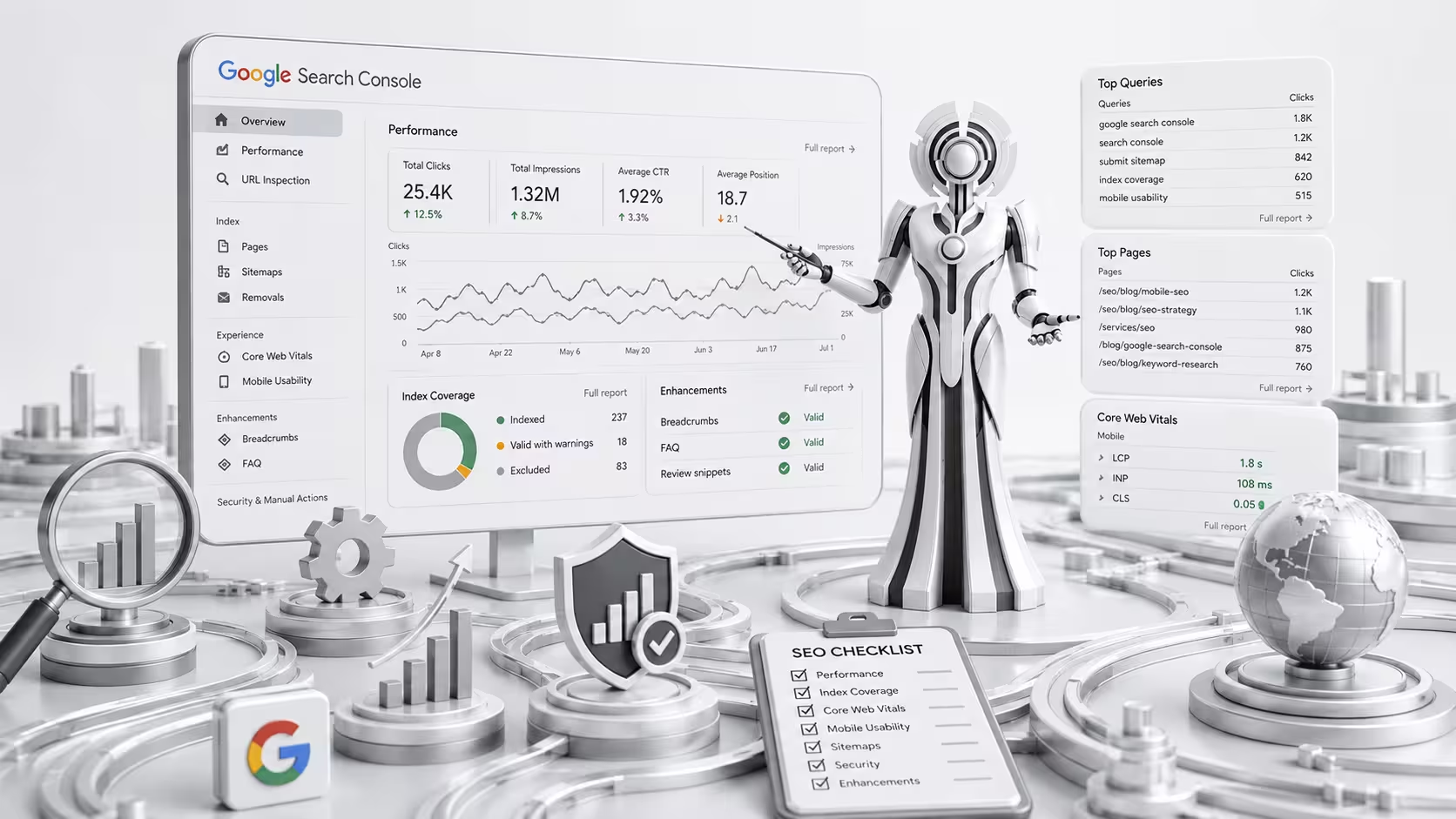
Once search systems understand your content, they evaluate how efficiently your website serves that information to human visitors. This area is heavily governed by Google’s Page Experience metrics, specifically a set of user-centric performance indicators known as Core Web Vitals.
For business leaders, these vital metrics boil down to three clear concepts:
┌────────────────────────────────────────────────────────────────────────┐
│                          CORE WEB VITALS METRICS                       │
├───────────────────────┬───────────────────────┬────────────────────────┤
│       LCP             │       INP             │       CLS              │
│ (Largest Contentful)  │ (Interaction to Next) │  (Cumulative Layout)   │
│ (     Paint        )  │ (     Paint       )   │  (     Shift      )    │
├───────────────────────┼───────────────────────┼────────────────────────┤
│ Visual Loading Speed  │ Responsiveness Timing │   Visual Stability     │
│   Target: ≤ 2.5s      │    Target: ≤ 200ms    │     Target: ≤ 0.1      │
└───────────────────────┴───────────────────────┴────────────────────────┘
-
Largest Contentful Paint (LCP): Measures visual loading speed. It tracks how long it takes for the primary piece of content on a page (like a hero image or main heading) to render fully on screen. To provide a high-quality experience, your LCP should occur within 2.5 seconds or less from when the page first starts loading.
-
Interaction to Next Paint (INP): Measures website responsiveness and interactivity. It tracks the delay between a user clicking a button, menu link, or input form, and the site displaying the updated visual response. A highly optimized, professional website must maintain an INP of 200 milliseconds or lower.
-
Cumulative Layout Shift (CLS): Measures visual stability. Have you ever tried to click a button on a mobile phone, only for the page to suddenly shift down, causing you to click an ad or the wrong link entirely? That is caused by a poor CLS metric. To prevent this frustrating behavior, elements must remain perfectly stable as they load, maintaining a strict score below 0.1.
Platform Snapshots: Technical SEO in the Real World
Technical SEO requirements look radically different depending on the technology stack powering your digital footprint. Let’s examine how these structural principles apply across different business models and software ecosystems.
eCommerce & Shopify Websites
High-volume online shops deal with thousands of dynamic landing pages, automated collection tags, and complex filtering menus. A major technical vulnerability in eCommerce is variant product duplication. For example, a single clothing item available in five sizes and four colors can inadvertently generate twenty identical URLs. Left unmanaged, this dilutes search authority and rapidly drains your crawl budget. Proper collection architecture and precise canonical tagging are critical to keep these platforms ranking effectively.
SaaS & JavaScript-Heavy Platforms
Modern Software-as-a-Service (SaaS) websites often rely on complex frameworks like React, Angular, or Vue to deliver sleek, interactive experiences. However, because these applications build their page content dynamically inside the browser using client-side JavaScript, standard search spiders often see a completely blank HTML page upon arrival. Ensuring your infrastructure uses Server-Side Rendering (SSR) or advanced pre-rendering protocols is vital so that search systems can immediately read your content without facing code execution blocks.
WordPress & Professional Service Sites
While WordPress offers exceptional flexibility out of the box, it is highly prone to “plugin bloat.” When non-technical marketing teams install dozens of third-party plugins to add minor stylistic features, the underlying source code becomes heavily weighed down with redundant CSS and JavaScript files. This significantly slows down page speed. Maintaining clean, lightweight database management, offloading media files to modern image formats, and implementing server-side caching are critical priorities for service-based businesses running on WordPress.
Local Business Websites
For enterprises targeting specific regions across the UK, technical optimization centers around explicit entity location signaling. This means deploying highly localized Schema Markup alongside clean mobile-first templates. Because local searches are predominantly executed on mobile devices while users are on the move, maintaining rapid load times and seamless responsive layouts is essential for securing real estate in localized map packs and voice search returns.
The Rankers Pro Technical SEO Framework
At Rankers Pro, we don’t believe in running automated tool scans, exporting generic reports, and leaving you to puzzle over the results. True optimization requires a systematic, professional engineering methodology. We developed our proprietary technical framework over seven years and across more than 350 successful website deployments.
[1. Crawl Audit] ──► [2. Index Diagnosis] ──► [3. Architecture Review]
                                                     │
[6. Schema Sync] ──► [5. Mobile UX Check] ──► [4. Core Web Vitals]
       │
[7. Internal Link Mapping] ──► [8. Fix Prioritisation] ──► [9. Implementation] ──► [10. GSC Monitoring]
-
Crawlability Audit: Deep raw log analysis and crawling using enterprise tools like Screaming Frog and Sitebulb to uncover precisely how search spiders interact with your server architecture.
-
Indexation Diagnosis: Pinpointing pages blocked by code errors, discovering rogue non-index directives, and clearing out dead weight to maximize search efficiency.
-
Site Architecture Review: Restructuring confusing directories into a highly logical, top-down hierarchy that helps link equity flow naturally to high-value pages.
-
Core Web Vitals & Speed Analysis: Deep code optimization, managing server resource allocations, script execution order tuning, and database optimization to keep your real-world load speeds within elite performance targets.
-
Mobile UX Review: Ensuring that rendering paths, font scales, touch target areas, and layouts adapt perfectly to mobile devices under Google’s mobile-first indexing protocols.
-
Schema & Entity Optimisation: Hand-crafting precise, validated JSON-LD data graphs to clearly connect your brand name, core offerings, and expertise directly inside search engine knowledge bases.
-
Internal Linking Mapping: Rebalancing internal text links to distribute ranking authority evenly to your most profitable conversion and lead-generation pages.
-
Technical Issue Prioritisation: Sorting all discovered structural code issues into an actionable, business-focused roadmap ranked by projected ROI and technical urgency.
-
Fix Implementation: Our experienced development and optimization specialists deploy clean code adjustments directly onto your staging or live environments, removing the burden from your internal team.
-
Monitoring Through Google Search Console: Continuous data analysis and system health checks to stay ahead of layout anomalies, index alerts, or algorithm adjustments before they can impact your bottom line.
Empower Your Growth Strategy
Technical SEO is an investment that compounds over time, laying the groundwork for all your content and marketing efforts. Book a Free SEO Consultation with Rankers Pro to map out a clear path toward sustainable online growth.
The Beginner-Friendly Technical Health Checklist
If you want to review the structural health of your website alongside your internal marketing or development team, use this foundational checklist to catch common underlying technical problems early.
🟩 1. Crawlability & Site Access
-
[ ] Robots.txt Status: Verify that your main service or product pages are not accidentally blocked from crawling.
-
[ ] Sitemap Validity: Ensure an accurate XML sitemap is actively submitted within Google Search Console.
-
[ ] Dead Ends Check: Run scans to detect and eliminate any
404 Broken Errorsembedded within internal text links.
🟦 2. Indexation Control
-
[ ] Canonical Alignment: Confirm that every unique page points directly to its correct canonical master URL.
-
[ ] Secure Protocol: Verify that every section of your domain is securely delivered using an updated HTTPS connection.
-
[ ] Duplicate Management: Check that automated tracking variables or search filters do not create indexable duplicate text blocks.
🟨 3. Performance & User Experience
-
[ ] Mobile Functionality: Ensure your pages pass Google’s responsive design and mobile-first layout checks.
-
[ ] Visual Load Target: Verify that your Largest Contentful Paint (LCP) clocks in well below the 2.5-second benchmark.
-
[ ] Interactive Speed: Confirm that your Interaction to Next Paint (INP) measures under 200 milliseconds for crisp responsiveness.
🟧 4. Semantic Metadata
-
[ ] Structured Markups: Confirm that valid JSON-LD schema strings are present to represent your core brand or local entity details.
-
[ ] Heading Hierarchy: Check that all pages use a single, distinct $H_1$ tag followed by an organized, descending heading structure ($H_2, H_3$).
Expert Insights & Common Pitfalls to Avoid
Throughout our years of optimizing complex website frameworks, we frequently see the same technical oversights stall otherwise excellent marketing campaigns. Avoiding these structural pitfalls can save your business from unexpected, costly drops in search visibility.
-
The Disconnected Redesign Disaster: A classic corporate mistake occurs when a company relocates a high-performing website to a brand-new layout or brand identity without setting up a precise, URL-by-URL
301 Redirectblueprint. This completely breaks years of accumulated link equity, causing search visibility and organic inbound leads to plummet overnight. Treating SEO as an afterthought during migrations can severely harm your digital presence. -
The Unchecked Redirect Chain: Over time, legacy sites often stack redirects on top of old redirects (e.g., Page A redirects to Page B, which points to Page C). This creates a laggy experience for users and causes search bots to give up on the path entirely, leaving valuable pages uncrawled. Cleaning up these paths keeps your site lightweight and crawl-efficient.
-
Over-Reliance on Automation Tools: While platform plugins can automate basic technical elements, relying on them completely without professional oversight often leads to a false sense of security. Automated tools cannot design a custom site architecture tailored to your business model, nor can they accurately resolve complex JavaScript rendering issues. True technical health requires regular, professional reviews by an expert specialist.
Audit Frequency Recommendation
A comprehensive, expert technical SEO audit should be conducted at least twice a year for standard business websites, and quarterly for rapidly changing eCommerce or enterprise environments. Regular checks ensure that minor code conflicts, plugin updates, or accidental structural changes are caught and corrected before they impact your conversion revenue.
Frequently Asked Questions
Is technical SEO hard?
The basic concepts of technical SEO—like ensuring your pages load fast and fixing broken links—are straightforward. However, resolving advanced issues like asynchronous JavaScript execution, setting up international hreflang tags for global audiences, and designing complex schema entity structures requires specialized developer knowledge and analytical experience.
Does technical SEO improve rankings?
Yes, it acts as a foundational ranking multiplier. If your technical setup is flawed, search engines will struggle to read your content, meaning even exceptional copy won’t rank well. Resolving structural errors allows your content to be indexed cleanly and rank to its full potential.
What tools are used for technical SEO?
Specialists use a balanced toolkit of diagnostics software. Free platform monitoring systems include Google Search Console, Google PageSpeed Insights, and Lighthouse. For deep domain analysis, professionals rely on advanced crawling tools like Screaming Frog SEO Spider, Sitebulb, Ahrefs, and Semrush.
What is the difference between technical SEO and on-page SEO?
Technical SEO focuses entirely on your backend infrastructure, server settings, and code optimization to help bots crawl and index your site effectively. On-page SEO deals with the customer-facing elements of your pages, including your written copy, heading keyword placement, image quality, and overall page relevance.
What are common technical SEO problems?
The most frequent structural issues include sluggish loading speeds caused by unoptimized media files, broken link structures, incorrect redirect paths, duplicate pages without proper canonical tags, and mobile layout display errors.
Conclusion & Strategic Next Steps
At its core, what is technical seo comes down to one clear business principle: providing a seamless, friction-free digital experience for both the search systems that catalog your website and the human audiences who buy from you.
When you invest in a fast, stable, and highly organized technical infrastructure, you ensure that every piece of content you write, every product you launch, and every marketing campaign you execute delivers the maximum possible return on investment.
If you are ready to stop guessing about your website health and want to turn your technical setup into a reliable revenue generator, partner with an experienced team that understands how code directly drives conversions.
Take the Lead in Search Visibility
Select the option that matches your current business goals to start optimization:
-
Option 1: Evaluate Your Performance
Get absolute clarity on your site health. Request a comprehensive evaluation from our specialists to uncover hidden errors and speed bottlenecks.
-
Option 2: Map Out Your Long-Term Strategy
Speak directly with an elite growth strategist to review your business model, design a custom architecture plan, and outpace your competitors.