A strong website needs more than great content and technical optimization to compete in search results. Search engines also consider signals from other websites when evaluating the credibility, authority, and relevance of a website.
This is where Link Building SEO becomes an important part of a broader SEO strategy.
Link building is the process of earning or acquiring links from other websites to your own website. However, successful link building is not about getting as many backlinks as possible. The focus should be on earning high-quality, relevant backlinks that provide genuine value.
In this guide, we will explain what Link Building SEO is, why backlinks matter, and effective white hat strategies businesses can use to build a stronger backlink profile in 2026.
What Is Link Building SEO?
Link Building SEO is the process of earning backlinks from other websites to improve a website’s authority, visibility, and discoverability.
A backlink is simply a hyperlink from one website to another.
For example, if a reputable digital marketing website publishes an article about SEO and links to your SEO guide as a useful resource, your website has earned a backlink.
Search engines can use links as signals for discovering pages and understanding relationships between websites and content.
However, not all backlinks are equal. A relevant, editorially placed link from a trustworthy website can be much more valuable than a large number of irrelevant or low-quality links.
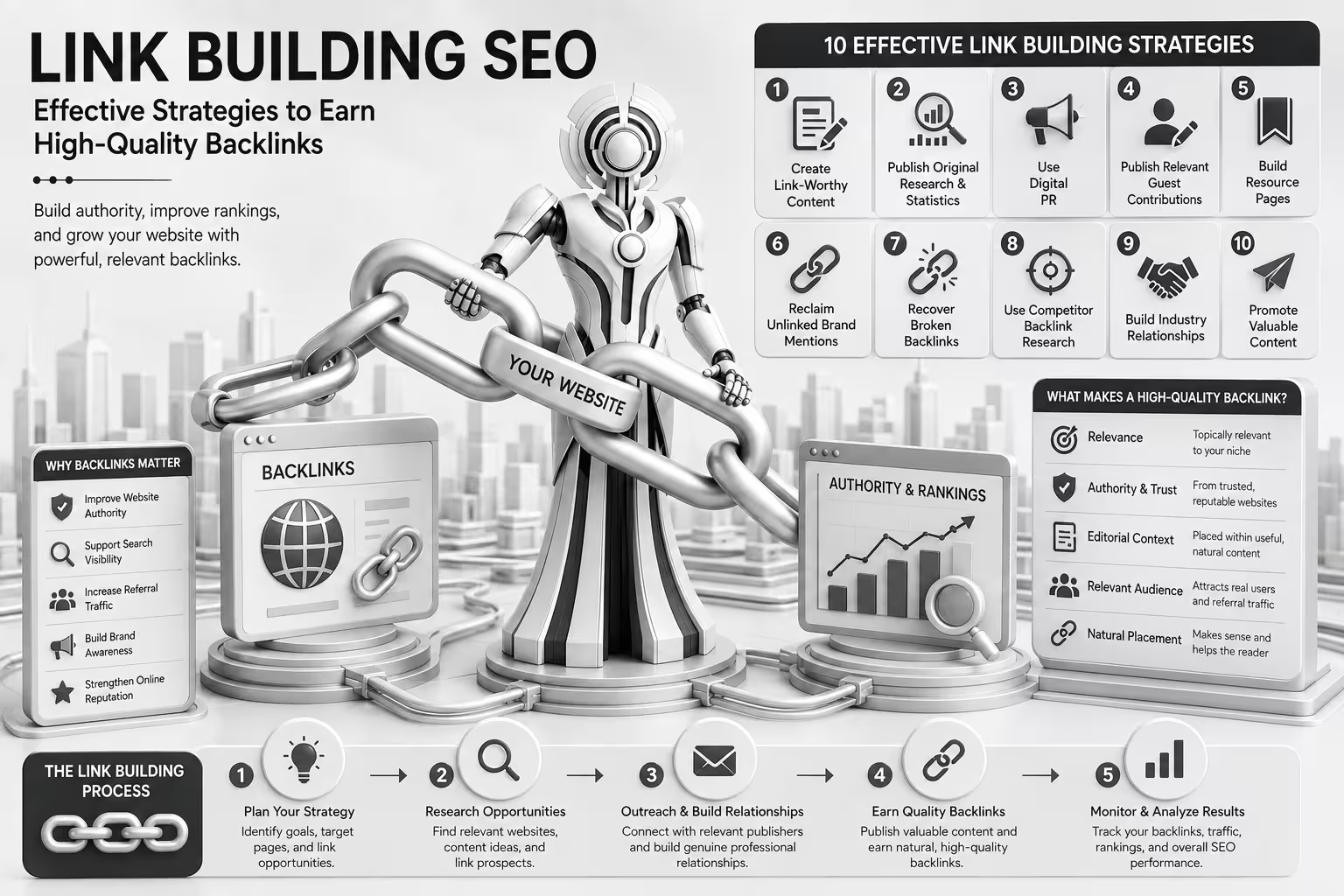
Why Are Backlinks Important for SEO?
Backlinks can play an important role in SEO because they can help search engines discover content and evaluate the authority and relevance of websites.
A strong backlink profile can potentially help with:
Improving Website Authority
Links from reputable websites can contribute to the credibility of your website.
Supporting Search Visibility
Quality backlinks can strengthen your website’s ability to compete for relevant search queries.
Increasing Referral Traffic
A useful backlink can send visitors directly from another website to your own.
Building Brand Awareness
Being mentioned by reputable publications and industry websites can expose your business to new audiences.
Strengthening Your Online Reputation
Consistent mentions from relevant and trustworthy sources can help establish your business as a credible participant in your industry.
What Makes a High-Quality Backlink?
The quality of a backlink matters more than simply increasing the number of links.
When evaluating a potential backlink, consider the following factors.
Relevance
The linking website or webpage should have a meaningful connection to your topic, industry, or audience.
For example, a backlink to an SEO agency from a relevant marketing publication makes more sense than a link from an unrelated website.
Authority and Trust
A link from an established and reputable website can provide stronger signals than a link from a low-quality or suspicious website.
Editorial Context
Links that are naturally included within useful content are generally more valuable than links placed solely for SEO purposes.
Relevant Audience
A website with an audience that could genuinely benefit from your content can provide valuable referral traffic.
Natural Placement
The link should make sense within the surrounding content and help the reader.
The objective should always be to earn links because your content is useful, not because you are trying to manipulate rankings.
What Is White Hat Link Building?
White hat link building refers to ethical SEO practices designed to earn backlinks naturally without attempting to manipulate search engine rankings through spam or deceptive techniques.
White hat strategies focus on:
- Creating useful content
- Building genuine industry relationships
- Digital PR
- Relevant outreach
- Expert contributions
- Original research
- Helpful resources
- Genuine business partnerships
These methods may take more time than spammy link-building tactics, but they are generally more sustainable for long-term SEO.
10 Effective Link Building Strategies
1. Create Link-Worthy Content
One of the best ways to earn backlinks is to create content that other websites genuinely want to reference.
Examples include:
- Original research
- Industry statistics
- Detailed guides
- Case studies
- Free tools
- Templates
- Checklists
- Original studies
- Expert roundups
- Useful resources
The more useful and unique your content is, the stronger the reason for another website to reference it.
2. Create Original Research and Statistics
Original data can be particularly effective for earning backlinks.
For example, a business could publish research about:
- Industry trends
- Customer behavior
- Market statistics
- Search trends
- Consumer preferences
Other writers and publishers may reference your findings when creating their own content.
This can generate natural backlinks while also establishing your business as a source of information.
3. Use Digital PR
Digital PR combines public relations with online content promotion.
You can create stories or resources that are genuinely useful to journalists, publications, bloggers, and industry websites.
Potential digital PR assets include:
- Original research
- Expert opinions
- Industry reports
- Surveys
- Data-driven stories
- Company announcements
The goal is to earn media coverage and relevant mentions rather than simply requesting links.
4. Publish Relevant Guest Contributions
Contributing useful content to relevant websites can be an effective link-building method when done properly.
The focus should be on:
- Relevant publications
- High-quality content
- Genuine expertise
- Useful information
- Appropriate contextual links
Avoid publishing low-quality articles across unrelated websites simply to obtain backlinks.
Guest contributions should be about providing value to the publication’s audience.
5. Build Resource Pages
Resource pages are collections of useful links and information about a specific subject.
If you have created a genuinely valuable guide, tool, research report, or resource, it may be appropriate to contact relevant websites that maintain resource pages.
Your outreach should explain why the resource would be useful to their readers.
6. Reclaim Unlinked Brand Mentions
Sometimes another website mentions your business but does not link to your website.
You can identify these mentions and contact the publisher to request a link when appropriate.
For example, if an industry article mentions your company as a source but does not link to your website, a polite outreach message may result in a useful backlink.
7. Recover Broken Backlinks
Websites sometimes remove pages, change URLs, or restructure their content.
This can result in broken backlinks pointing to pages that no longer exist.
Review your backlink profile regularly to identify valuable broken links.
If you have a suitable replacement page, you may be able to request that the linking website update the old URL.
8. Use Competitor Backlink Research
Competitor analysis can reveal websites that already link to businesses in your industry.
Look for patterns such as:
- Industry publications
- Resource pages
- Business directories
- Partner websites
- Relevant blogs
- Industry associations
Do not blindly copy competitor backlink profiles.
Instead, use the research to identify opportunities where your own content can provide genuine value.
9. Build Industry Relationships
Strong professional relationships can create long-term opportunities for collaboration and content promotion.
Connect with:
- Industry experts
- Bloggers
- Journalists
- Business owners
- Publishers
- Professional organizations
Relationships can lead to interviews, collaborations, expert contributions, partnerships, and natural mentions.
10. Promote Valuable Content
Publishing content is only the first step.
Promote useful resources through appropriate channels such as:
- Social media
- Email newsletters
- Industry communities
- Professional networks
- Direct outreach
- Partnerships
Content promotion increases the chances that the right people will discover and reference your content.
What Is a Backlink Strategy?
A backlink strategy is a structured plan for earning relevant and high-quality backlinks over time.
Instead of randomly searching for websites that accept links, start by identifying:
- Which pages need more authority?
- Which content is worth promoting?
- Which websites are relevant to your industry?
- Which publications reach your target audience?
- What unique value can you offer them?
Your strategy should focus on quality, relevance, and sustainability.
How to Choose Websites for Link Building
Not every website is a good link-building target.
Before pursuing a backlink, consider:
Topical Relevance
Does the website publish content related to your industry?
Content Quality
Does the website publish useful, original content?
Real Audience
Does the website appear to have a genuine audience?
Editorial Standards
Does the website maintain reasonable publishing standards?
Reputation
Does the website have a trustworthy reputation?
Avoid websites that exist primarily to sell backlinks or publish large quantities of unrelated content.
Anchor Text in Link Building
Anchor text is the clickable text used in a hyperlink.
For example:
Learn more about Technical SEO
is anchor text pointing to another webpage.
A natural backlink profile can contain different types of anchor text, including:
- Brand names
- Website names
- Natural phrases
- Partial keyword phrases
- Descriptive text
- URLs
Avoid trying to force the exact same keyword into every backlink.
Anchor text should make sense for users and accurately describe the destination page.
Internal Links vs. Backlinks
These two types of links are often confused.
Internal Links
Internal links connect pages within your own website.
For example:
YourWebsite.com/seo-services/ → YourWebsite.com/technical-seo/
They help users navigate your website and help search engines understand your site structure.
Backlinks
Backlinks come from other websites.
For example:
OtherWebsite.com → YourWebsite.com
Backlinks can contribute to external authority signals and can also generate referral traffic.
Both internal linking and external backlinks can be important parts of a comprehensive SEO strategy.
Link Building Mistakes to Avoid
Some link-building practices can create more problems than benefits.
Buying Links to Manipulate Rankings
Purchasing links specifically to influence search rankings can violate search engine guidelines.
Link Farms
Avoid networks created primarily to generate artificial backlinks.
Irrelevant Backlinks
A link from an unrelated website may have little value and can make your backlink profile look unnatural.
Excessive Exact-Match Anchor Text
Using the same keyword-rich anchor text repeatedly can create an unnatural pattern.
Low-Quality Guest Posts
Publishing poorly written articles on unrelated websites just to obtain links is not a sustainable strategy.
Automated Link Building
Automated tools that generate large numbers of backlinks can create spammy links and potentially expose your website to unnecessary risk.
Focusing Only on Quantity
Getting 100 irrelevant backlinks is not necessarily better than earning a few strong links from highly relevant websites.
How Link Building Services Can Help
Professional link building services can help businesses develop a structured strategy for earning relevant backlinks.
Depending on the business and campaign, professional services may include:
- Backlink audits
- Competitor backlink analysis
- Link opportunity research
- Content-led link building
- Digital PR
- Outreach campaigns
- Guest contribution opportunities
- Broken link opportunities
- Unlinked brand mention recovery
- Backlink monitoring
A professional strategy should focus on earning quality links rather than promising a specific number of backlinks.
How to Measure Link Building Success
Do not measure a link-building campaign only by the number of links acquired.
Useful metrics include:
- Quality referring domains
- Relevant backlinks
- Referral traffic
- Organic search visibility
- Keyword rankings
- Brand mentions
- Organic traffic
- Leads and conversions
A backlink that sends relevant visitors and strengthens your brand can be more valuable than dozens of links that generate no meaningful traffic.
Link Building SEO Checklist
Before starting a link-building campaign, review the following:
- Create valuable, link-worthy content
- Identify relevant websites
- Analyze competitor backlinks
- Research industry publications
- Build genuine relationships
- Use ethical outreach
- Promote original research and useful resources
- Monitor unlinked brand mentions
- Recover valuable broken backlinks
- Keep anchor text natural
- Avoid spammy link-building methods
- Monitor backlink quality
- Track referral traffic and organic performance
Final Thoughts
Link Building SEO remains an important part of building a strong and competitive website. However, effective link building is no longer about collecting large numbers of backlinks.
The strongest approach is to create valuable content, build genuine industry relationships, earn relevant mentions, and use white hat link building techniques that provide real value to publishers and their audiences.
High-quality backlinks can support website authority, search visibility, referral traffic, and brand awareness when they are earned naturally and placed in relevant contexts.
If your business needs help developing a sustainable backlink strategy, professional link building services can help identify opportunities and build a campaign around your industry’s audience, competitors, and business goals.