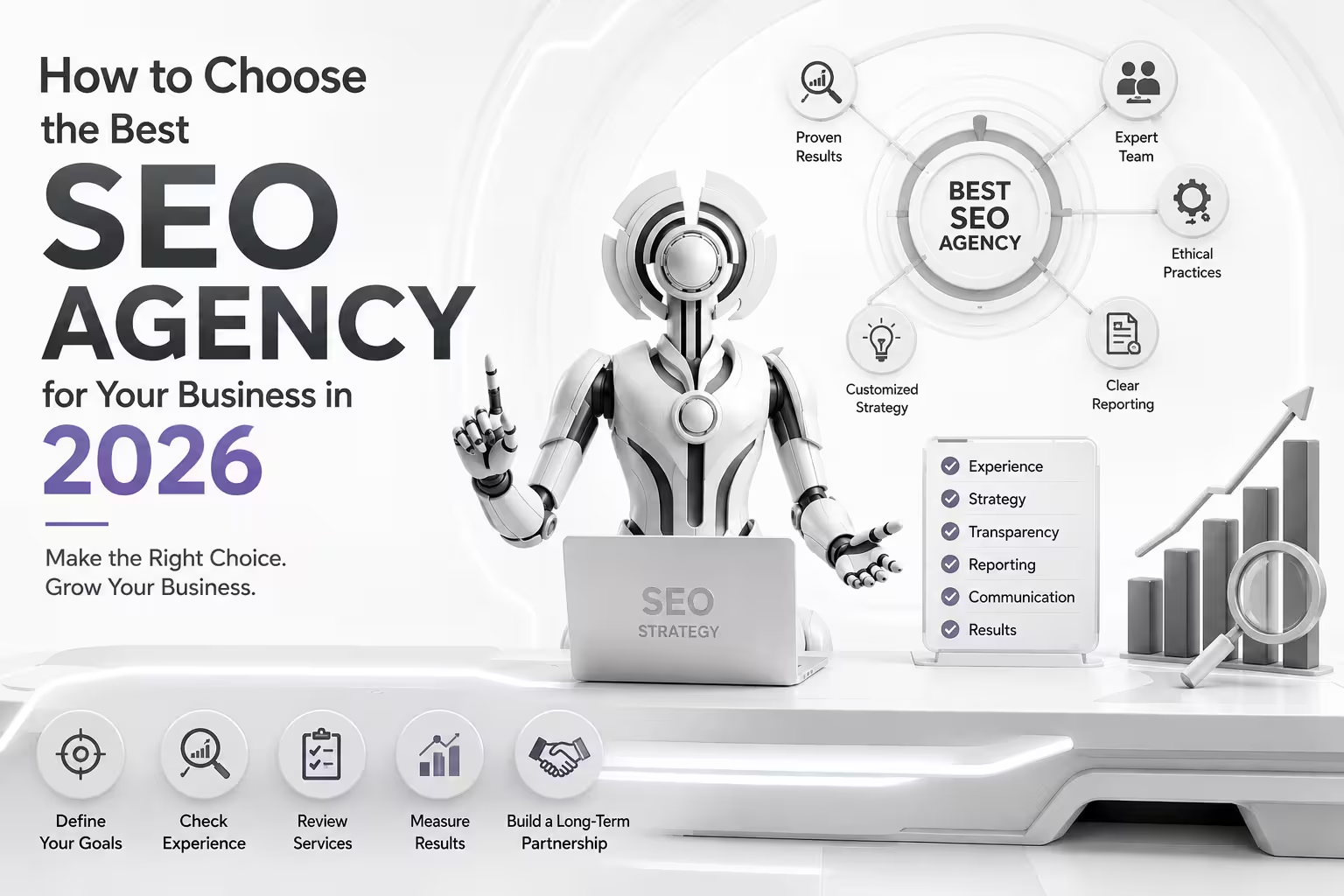
Choosing the best SEO agency for your business can have a major impact on your online visibility, organic traffic, leads, and sales. With so many SEO companies offering different packages and promises, it can be difficult to know which agency is actually right for your business.
The right SEO partner should do more than promise higher rankings. A professional agency should understand your business goals, target audience, competition, website, and industry before creating an SEO strategy.
In this guide, we’ll explain how to evaluate an SEO company, what services to look for, which questions to ask, and the warning signs you should avoid when choosing an SEO agency in 2026.
What Does an SEO Agency Do?
An SEO agency helps businesses improve their visibility in organic search engine results.
Depending on your business and website, an agency may provide:
- Keyword research
- Technical SEO
- On-page SEO
- Content optimization
- Local SEO
- Ecommerce SEO
- Link building
- Website audits
- Competitor research
- Internal linking
- Website performance optimization
- SEO reporting
The exact services you need depend on your website and business objectives.
For example, a local business may need strong local SEO, while an ecommerce store may require product and category optimization.
A good agency should not simply sell you a standard package. It should develop a strategy around your specific needs.
Why Choosing the Right SEO Company Matters
SEO can become a significant long-term investment for a business.
Working with the right agency can help you:
- Increase organic visibility
- Attract relevant website visitors
- Generate qualified leads
- Improve website performance
- Build online authority
- Reach customers searching for your services
- Increase organic conversions
On the other hand, choosing an inexperienced or unethical provider can waste your budget and potentially create SEO problems.
This is why it is important to evaluate an SEO company carefully before signing a contract.
10 Things to Consider When Choosing the Best SEO Agency
1. Understand Your SEO Goals First
Before contacting an SEO agency, define what you want to achieve.
Your goals might include:
- Increasing organic traffic
- Improving rankings
- Generating more leads
- Increasing ecommerce sales
- Improving local visibility
- Growing a specific service
- Launching a new website
- Expanding into a new market
For example, saying:
“I want more traffic”
is less useful than:
“I want to generate more qualified leads from customers searching for our services.”
Clear goals make it easier to evaluate whether an agency’s strategy is suitable for your business.
2. Look for Relevant SEO Experience
SEO is not exactly the same for every industry.
An agency that has experience with businesses similar to yours may understand your audience, competitors, search intent, and challenges more quickly.
Ask potential agencies:
- Have you worked with businesses in my industry?
- What types of websites have you optimized?
- Do you have experience with local SEO?
- Do you work with ecommerce websites?
- Have you worked with websites similar to mine?
Relevant experience does not guarantee results, but it can be a useful factor when comparing agencies.
3. Review Their SEO Services
A professional SEO agency should be able to explain exactly what it plans to do.
Depending on your website, professional SEO services may include:
Technical SEO
Identifying and fixing issues related to crawling, indexing, website architecture, redirects, performance, and other technical factors.
On-Page SEO
Optimizing page titles, headings, content, internal links, images, and other page elements.
Keyword Research
Finding relevant search terms based on search intent, competition, and business value.
Content Optimization
Improving existing content and creating new content that addresses valuable search queries.
Local SEO
Improving visibility for location-based searches and optimizing relevant local signals.
Ecommerce SEO
Optimizing product pages, category pages, collections, filters, and ecommerce website structures.
A good agency should explain which services your website actually needs rather than recommending everything automatically.
4. Ask How They Measure SEO Success
A good SEO campaign should be measurable.
Ask the agency which metrics it will track.
These may include:
- Organic traffic
- Search impressions
- Keyword visibility
- Keyword rankings
- Organic leads
- Conversions
- Ecommerce revenue
- Conversion rate
- Click-through rate
However, rankings should not be the only metric.
A business can rank for hundreds of keywords and still generate very few customers.
The ultimate goal should be to improve meaningful business outcomes.
5. Ask for Case Studies and Examples
Before hiring an SEO agency, ask whether they can provide relevant case studies or examples of previous work.
Look for information such as:
- What problem did the client have?
- What strategy was implemented?
- What improvements occurred?
- How long did the campaign run?
- What business results were achieved?
Be cautious if an agency only provides vague statements such as:
“We increased traffic by 500%.”
Ask for more context.
Was the traffic relevant?
Did leads or sales increase?
What was the starting point?
What timeframe was involved?
Good case studies should provide enough context to understand what was actually achieved.
6. Avoid Agencies That Guarantee #1 Rankings
One of the biggest warning signs is a company promising a guaranteed number-one ranking on Google.
Search rankings depend on many factors, including:
- Competition
- Search intent
- Website quality
- Content
- Authority
- Search engine changes
- Competitor activity
No legitimate SEO company can completely control Google’s organic results.
A professional agency should explain what it can influence and set realistic expectations.
7. Ask About Their SEO Strategy
Before hiring an agency, ask:
“What is your SEO strategy for my website?”
A professional SEO company should be able to explain its approach.
The strategy may include:
- Website audit
- Keyword research
- Competitor analysis
- Technical optimization
- On-page improvements
- Content strategy
- Internal linking
- Authority building
- Performance monitoring
- Continuous optimization
The strategy should be customized according to your website rather than copied from another client.
8. Check Their Communication and Reporting
Communication is an important part of a successful SEO relationship.
Ask:
- How often will you provide reports?
- Who will manage my account?
- How can I contact your team?
- Will you explain the work being completed?
- What information will be included in monthly reports?
A useful SEO report should explain:
- What was done
- What changed
- What improved
- What problems were found
- What will be done next
Avoid reports that contain complicated charts but provide little explanation about actual business performance.
9. Understand the Pricing
SEO pricing can vary significantly depending on the agency, website size, competition, services, and campaign objectives.
Some agencies charge:
- Monthly retainers
- Project-based fees
- Hourly rates
- Customized packages
Do not automatically choose the cheapest agency.
An extremely low price may mean limited work, poor-quality content, automated processes, or insufficient resources.
At the same time, a high price does not automatically mean better SEO.
Instead, compare:
Price + services + experience + strategy + communication + expected business value.
10. Make Sure You Own Your Website and SEO Assets
This is an important consideration that businesses sometimes overlook.
You should maintain appropriate ownership and access to important business assets, including:
- Website
- Domain
- Google accounts
- Analytics
- Search Console
- Business profiles
- Advertising accounts
- Website hosting
An SEO agency should be working on your behalf rather than making your business dependent on accounts you cannot access.
Before starting a campaign, clarify ownership and access responsibilities.
Questions to Ask an SEO Agency Before Hiring
Before making a decision, consider asking these questions:
About Experience
- How long have you been providing SEO services?
- Have you worked with businesses in my industry?
- Can you show relevant case studies?
About Strategy
- What would you change on my website?
- How will you choose target keywords?
- How will you analyze my competitors?
- What will your first three months look like?
About Reporting
- What will you include in monthly reports?
- How will you measure conversions?
- How often will we review performance?
About Content
- Who creates the content?
- Is content written specifically for my audience?
- How do you ensure content quality?
About Link Building
- How do you build backlinks?
- What types of websites do you target?
- How do you evaluate link quality?
About Contracts
- Is there a minimum contract period?
- Can I cancel the service?
- What happens to the work if I stop working with you?
Clear answers to these questions can help you compare agencies more effectively.
What Makes a Good SEO Agency?
The best SEO agency is not necessarily the one making the biggest promises.
A strong agency should demonstrate:
Transparency
You should understand what the agency is doing and why.
Realistic Expectations
Good SEO takes time, and professional agencies should communicate realistic timelines.
Customized Strategy
Your SEO strategy should be based on your website, industry, audience, and competition.
Technical Knowledge
The agency should understand both technical and content-related SEO.
Business Understanding
SEO should support your business goals rather than focus only on rankings.
Clear Reporting
You should receive understandable reports showing meaningful progress.
Long-Term Thinking
SEO should focus on sustainable growth rather than shortcuts.
SEO Agency Red Flags to Avoid
Be careful if an agency:
Guarantees Specific Rankings
No agency can guarantee a specific Google ranking.
Promises Instant Results
SEO generally requires time and consistent effort.
Uses “Secret SEO Techniques”
Professional SEO should not depend on mysterious tactics that the client is not allowed to understand.
Refuses to Explain Its Strategy
You should be able to understand the general approach being used on your website.
Focuses Only on Keyword Rankings
Rankings are useful, but traffic, leads, conversions, and revenue are often more important.
Offers Thousands of Backlinks
More backlinks do not automatically mean better SEO.
Quality and relevance matter.
Wants Complete Control of Your Accounts
Your business should retain appropriate ownership and access to important digital assets.
Should You Hire a Local or International SEO Agency?
There is no universal answer.
A local SEO agency may understand your local market and customer behavior more closely.
An international agency may have broader experience across industries and markets.
The more important questions are:
- Do they understand your target market?
- Can they communicate effectively?
- Do they have relevant experience?
- Can they demonstrate a clear strategy?
- Do their services fit your goals?
Choose based on capability and fit rather than location alone.
SEO Agency vs Freelancer: Which Is Better?
Both can be effective.
SEO Agency
An agency may provide access to multiple specialists, such as:
- SEO specialists
- Content writers
- Developers
- Technical SEO experts
- Link-building specialists
This can be useful for larger or more complex projects.
SEO Freelancer
A skilled freelancer may provide more direct communication and can sometimes be a cost-effective option for smaller websites.
The right choice depends on your website size, budget, SEO requirements, and the level of expertise needed.
How Much Should You Spend on SEO?
There is no universal SEO budget.
Your investment may depend on:
- Website size
- Industry competition
- Number of target locations
- Number of products or services
- Content requirements
- Technical issues
- Business goals
Instead of choosing an SEO package solely based on price, consider the potential value of acquiring new customers through organic search.
For example, if one qualified customer is worth significant revenue to your business, investing in a strategy that consistently generates qualified leads may provide substantial long-term value.
What to Expect During the First Few Months
A professional SEO campaign usually starts with research and website analysis.
Month 1
The agency may focus on:
- SEO audit
- Keyword research
- Competitor analysis
- Technical review
- Strategy development
Months 2–3
Work may include:
- Technical fixes
- On-page optimization
- Content improvements
- Internal linking
- Website performance improvements
Following Months
The focus may expand to:
- Content development
- Authority building
- Ranking improvements
- Conversion optimization
- Continuous technical SEO
- Performance analysis
The exact timeline depends on the website and competition.
How to Compare SEO Agencies
If you have several agencies to choose from, create a simple comparison.
| Factor | Agency A | Agency B | Agency C |
|---|---|---|---|
| Relevant experience | ✓ | ✓ | — |
| Clear strategy | ✓ | — | ✓ |
| Case studies | ✓ | ✓ | — |
| Transparent pricing | ✓ | — | ✓ |
| Regular reporting | ✓ | ✓ | — |
| Technical SEO | ✓ | ✓ | ✓ |
| Content strategy | ✓ | — | ✓ |
| Realistic expectations | ✓ | — | ✓ |
The agency with the lowest price is not necessarily the best option.
Look at the complete picture.
Final Checklist Before Hiring an SEO Agency
Before signing a contract, make sure you understand:
- What SEO services are included
- What your main goals are
- Which keywords and pages will be targeted
- How the strategy will be developed
- How technical issues will be handled
- Who will create content
- How backlinks will be acquired
- How progress will be measured
- How often reports will be provided
- What the contract includes
- Who owns your website and accounts
- What happens if you end the contract
If these points are clear, you are in a much better position to make an informed decision.
Frequently Asked Questions About Choosing an SEO Agency
How do I choose the best SEO agency?
Start by defining your goals, reviewing the agency’s relevant experience, asking for case studies, understanding its SEO strategy, checking reporting practices, and comparing the value of its services rather than choosing based only on price.
How much do SEO services cost?
SEO costs vary depending on the website, industry, competition, services required, and campaign goals. There is no single price that applies to every business.
Can an SEO company guarantee first-page rankings?
No legitimate agency can guarantee a specific Google ranking. Search results are influenced by many factors outside an agency’s complete control.
How long does it take for SEO to produce results?
SEO results can take several months, although the timeframe varies significantly depending on competition, website quality, content, technical health, authority, and the strategy being implemented.
Should a small business hire an SEO agency?
A small business can benefit from professional SEO services if organic search is an important customer acquisition channel. However, the agency should offer a strategy appropriate for the business’s size, goals, and budget.
What is the difference between an SEO company and an SEO agency?
The terms are often used interchangeably. Both generally refer to businesses that provide search engine optimization services to clients.
Final Thoughts
Choosing the best SEO agency is an important business decision.
The right agency should not simply promise rankings. It should understand your business, identify realistic opportunities, create a customized strategy, communicate clearly, and measure SEO performance against meaningful business goals.
Before hiring an SEO company, evaluate its experience, services, case studies, strategy, reporting, pricing, and communication.
Most importantly, avoid unrealistic promises such as guaranteed rankings or instant results.
A strong SEO partnership is built on transparency, expertise, realistic expectations, and consistent work.
If you choose an agency that focuses on sustainable organic growth rather than shortcuts, your SEO investment can become a valuable part of your long-term digital marketing strategy.